- VivaChek ECO Blood Glucose Monitoring System
- VivaChek FAD Blood Glucose Monitoring System
- VivaChek Pro Point-of-Care Testing System
- VivaChek Electronic Arm Type Blood Pressure Monitor
- VivaDiag Multi-Drug Rapid Test Saliva Cube
- VivaDiag Multi-Drug Rapid Test Cup
- VivaChek Blood Glucose Test Strip
- DeVita-Fine 4 Insulin Pen Needle
- DeVita-Fine 5 Insulin Pen Needle
- DeVita-Fine 6 Insulin Pen Needle
- DeVita-Fine 8 Insulin Pen Needle
VivaCheck Blood Pressure Monitor - Digital Blood Pressure Monitor from Upper Arm
VivaCheck Blood Pressure Monitor is an easy-to-use and reliable digital blood pressure monitor that can measure blood pressure from the upper arm. It is an ideal solution for those who want to monitor their blood pressure regularly at home.
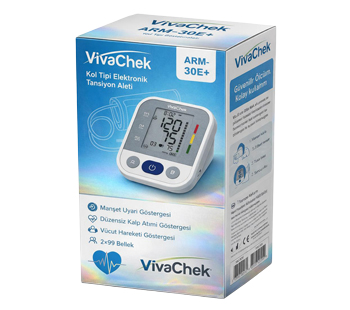
Device Features
- - Automatic blood pressure measurement from the upper arm
- - Large and clear LCD display
- - Systolic and diastolic blood pressure display
- - Pulse (heart rate) measurement
- - 2 x 60 measurement memory (120 records)
- - Irregular heartbeat (IHB) detection
- - WHO blood pressure classification indicator
- - Average value calculation
- - Easy measurement with one button
- - Automatic power off feature
Display and Parts
| Part | Description |
|---|---|
| LCD Display | Main screen where measurement results are displayed |
| SET/MEM Button | Setting and memory functions |
| START/STOP Button | Start and stop measurement |
| Cuff Connection | Point where the arm cuff connects to the device |
| Battery Compartment | Compartment for 4 AA batteries (back of device) |
Preparation Before Use
Battery Installation
- 1. Open the battery cover on the back of the device
- 2. Insert 4 AA batteries paying attention to polarity
- 3. Close the battery cover
- 4. All symbols will be displayed on the screen
Cuff Connection
- 1. Insert the cuff hose into the connection point on the left side of the device
- 2. Make sure the connection is tight
Date and Time Setting
- 1. Press and hold the SET/MEM button for 3 seconds
- 2. The year will start flashing
- 3. Adjust the value with the START/STOP button
- 4. Switch to the next setting with the SET/MEM button
- 5. Set year, month, day, hour, and minute respectively
- 6. Save by pressing SET/MEM after the last setting
How to Measure Blood Pressure?
Important Notes Before Measurement:
- - Do not consume caffeine, alcohol, or smoke 30 minutes before measurement
- - Rest for 5 minutes before measurement
- - Always measure from the same arm
- - Do not talk or move during measurement
- - Arm should be at heart level
Measurement Steps:
- 1. Sit comfortably with feet flat on the floor
- 2. Wrap the cuff around your left arm, 2-3 cm above the elbow
- 3. The cuff hose should face the inner arm
- 4. Check cuff tightness (one finger should fit comfortably)
- 5. Rest your arm on a table or support
- 6. Press the START/STOP button
- 7. The device will automatically inflate and measure
- 8. Results will appear on the screen when measurement is complete
Understanding Measurement Results
| Symbol | Meaning |
|---|---|
| SYS | Systolic pressure (large blood pressure) - mmHg |
| DIA | Diastolic pressure (small blood pressure) - mmHg |
| PUL | Pulse (heartbeats per minute) |
| ❤️ icon | Irregular heartbeat detected |
Blood Pressure Classification (WHO Standards)
| Classification | Systolic (mmHg) | Diastolic (mmHg) |
|---|---|---|
| Optimal | < 120 | < 80 |
| Normal | 120-129 | 80-84 |
| High Normal | 130-139 | 85-89 |
| Mild Hypertension (Grade 1) | 140-159 | 90-99 |
| Moderate Hypertension (Grade 2) | 160-179 | 100-109 |
| Severe Hypertension (Grade 3) | ≥ 180 | ≥ 110 |
Memory Function
The device can store a total of 120 measurements for 2 users (60 records for each user).
Viewing Saved Measurements:
- 1. Short press the SET/MEM button
- 2. Navigate through records with the START/STOP button
- 3. Each record is displayed with date and time information
Average Value:
The average of the last 3 measurements is automatically calculated and shown with the "AVG" icon.
Irregular Heartbeat (IHB) Indicator
If an irregular heartbeat is detected during measurement, the heart icon appears on the screen. In this case:
- - Stay calm and rest for a few minutes
- - Repeat the measurement
- - Consult your doctor if irregular heartbeat appears constantly
Error Messages
| Error | Meaning | Solution |
|---|---|---|
| E1 | Cuff pressure too low | Wrap the cuff correctly and try again |
| E2 | Air leak | Check cuff and hose connection |
| E3 | Measurement failed | Make sure you are in the correct position and try again |
| E4 | Movement detected | Stay still during measurement |
Maintenance and Cleaning
- - Clean the device with a dry and soft cloth
- - Wipe the cuff gently with a wet cloth, do not wash
- - Do not drop the device or subject it to impact
- - Protect from direct sunlight and moisture
- - Storage Temperature: 10°C - 40°C
- - Storage Humidity: 30% - 85%
Technical Specifications
| Feature | Value |
|---|---|
| Measurement Method | Oscillometric |
| Measurement Range (Pressure) | 0-299 mmHg |
| Measurement Range (Pulse) | 40-199 beats/minute |
| Accuracy (Pressure) | ±3 mmHg |
| Accuracy (Pulse) | ±5% |
| Cuff Size | 22-32 cm (standard arm circumference) |
| Memory | 2 x 60 records |
| Power Source | 4 x AA batteries (1.5V) |
| Auto Power Off | 1 minute |
| Operating Temperature | 10°C - 40°C |
| Storage Temperature | -20°C - 55°C |
Box Contents
- - 1 x VivaCheck Blood Pressure Monitor Main Unit
- - 1 x Arm Cuff (22-32 cm)
- - 1 x User Manual
- - 1 x Storage Case
What is Hypertension (High Blood Pressure)?
Hypertension is a condition where blood pressure is above normal values. It usually does not show symptoms and is known as the "silent killer". If left uncontrolled, it increases the risk of heart attack, stroke, and kidney disease.
Risk Factors:
- - Family history
- - Age (over 55)
- - Obesity
- - Sedentary lifestyle
- - Excessive salt consumption
- - Alcohol and smoking
- - Stress
Recommendations for Blood Pressure Control:
- - Exercise regularly
- - Reduce salt intake
- - Maintain a healthy weight
- - Avoid smoking and alcohol
- - Manage stress
- - Measure blood pressure regularly
- - Use medications prescribed by your doctor regularly